
How Interfaith Engagement Works: A Story From the World Cup
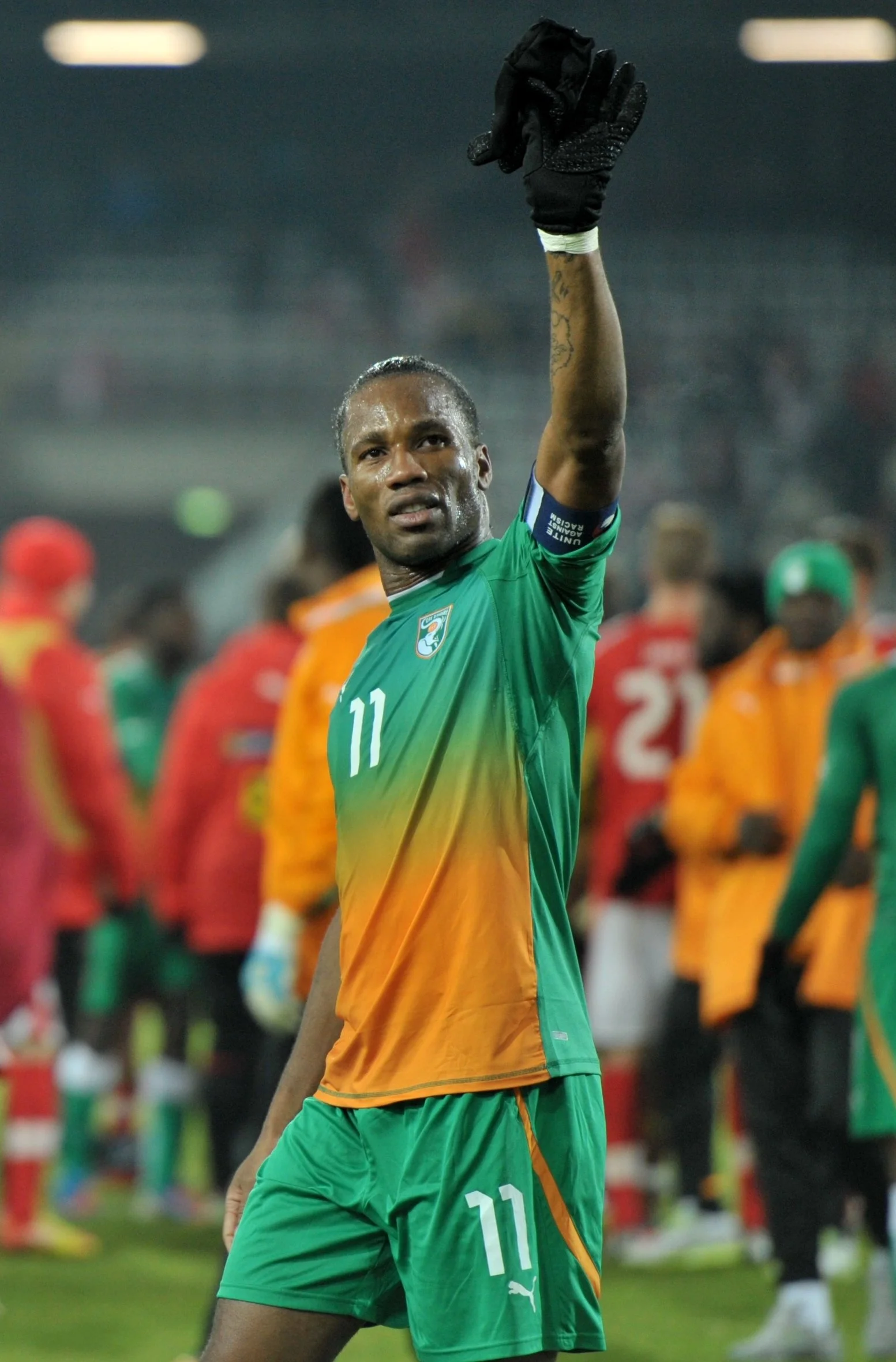
Photo: Ailura, CC BY-SA 3.0 AT <https://creativecommons.org/licenses/by-sa/3.0/at/deed.en>, via Wikimedia Commons
On October 8, 2005, the Côte d'Ivoire men’s national football team qualified for their first ever World Cup when they beat Sudan.
Back home, the Côte d'Ivoire was still in a civil war. Religious and cultural divisions were at the center of the conflict. The country is majority Muslim in the north, Christian in the south. Anti-Burkinabé immigrant rhetoric reached new high points when a candidate for the supreme court was prevented because of his ethnic ties to Burkina Faso. Following the death of Félix Houphouët-Boigny, the country’s founding president, war broke out and rebels occupied the north.
The country was divided. New boundaries were being made. And the football team came from every corner of Côte d'Ivoire.
And then the unexpected happened.
Didier Drogba was the team’s star striker and captain. On the field, he would be named African Footballer of the Year twice and finished his career as the fourth highest scorer of his premier league club. He was a Catholic from Abidjan, the capital city in the southernmost part of the country. His then wife was a Muslim from Mali.
Kolo and Yaya Touré, two brothers and standout players, are Muslim. They were born in Bouaké, the rebel capital and a symbol of the other side of the conflict. The whole team was like this—representing various tribal groups, culture, and religions.
Famously, after qualifying for the 2006 World Cup, the team celebrated in the locker room by calling for peace. And they called for it by modeling it.
Drogba, surrounded by teammates, grabs a microphone and looks into the camera in the locker room. “Men and women of Ivory Coast. From the north, south, centre, and west, we proved today that all Ivorians can coexist and play together with a shared aim. We promised you that the celebrations would unite the people,” he tells his countrypeople.
“Today we beg you, on our knees,” he says, as the team drops to their knees and link arms together. Kolo Touré, a Muslim from the North, is one of the men who wraps his arm around Drogba. “Forgive. Forgive. Forgive. The one country in Africa with so many riches must not descend into war like this. Please, lay down all weapons. Hold elections, organize elections. Then, all will be better.” They break into song and celebrate. The video is sometimes credited with unifying the nation and ending war (more on this later).
The Les Éléphants as the Côte d'Ivoire national team is called, show how interfaith engagement works on a practical level.
At Interfaith Photovoice, we believe dialogue’s power to bring change to individuals—and also communities—starts by affecting hearts and minds. Three elements are necessary for this to happen. The contact must be 1) positive, 2) collaborative, and 3) equal. Researchers use the term “contact theory” to describe this process.
The pitch became a contact zone for Les Éléphants. They worked hard and qualified for the World Cup for the first time in history (positive). Football is a team sport and they had to play as a team to win the game and others preceding it (collaborative). And, of course, they chose to equally present Northerns and Southerners, Muslims and Christians, and everyone in between as equally Ivorian. Kolo Touré’s arm holding Drogba symbolizes this equality.
Though we only see the fruit of the work, it’s obvious how important these men were to each other despite their differences. They must have built and cultivated deep relationships on their journey to the World Cup. These relationships, and others like them, show the power of interfaith engagement.
We are not here to say that the conflict ended because of the actions of this soccer team. That is too simplistic of a narrative and the actual violence was mostly at a pause in 2005 anyway. That’s not to say Drogba or his teammates were irrelevant to the ongoing process of unifying the country either. Drogba helped convince authorities to relocate an African Cup of Nations qualifier match from Abidjan to the stadium of Bouake—a move that some say symbolically confirmed the peace process. He was also one of 11 members to serve on the Truth and Reconciliation Commission, modeled on the more famous South African commission, following the post-election violence of the 2010-2011 Ivorian Crisis. It’s entirely possible that if Drogba had not been so close to his teammates that a different history may have been written.
Drogba may not have ended a war, as is often claimed, but he and his teammates modeled how building relationships across differences are fundamental to peace and mutual flourishing.