
“There’s more to it than that!”
“There’s more to it than that!”
When I first viewed the photograph of the gazebo at Wellington Cove (pseudonym), I immediately wondered what it had to do with religion. Perhaps it had something to do with its location. Or was the view from this place somehow significant? Maybe something extraordinary happened (or happens) here. Could there be a connection with the architecture, the structure’s design, or appearance? Does the absence of people suggest that this place is set apart, its access restricted for certain times or events, or is it simply the off season and everyone has gone south for the winter? Perhaps it is the intensity of the sun or the mysterious ring of light that gives the picture an otherworldly appearance—was that effect intentional? My initial viewing of a photograph rarely apprehended the levels of meaning that would emerge as participants told their stories. The objects themselves were sometimes identifiably “religious,” but these were pictures of “spaces,” spaces that took on their meaning in the stories lived in them.
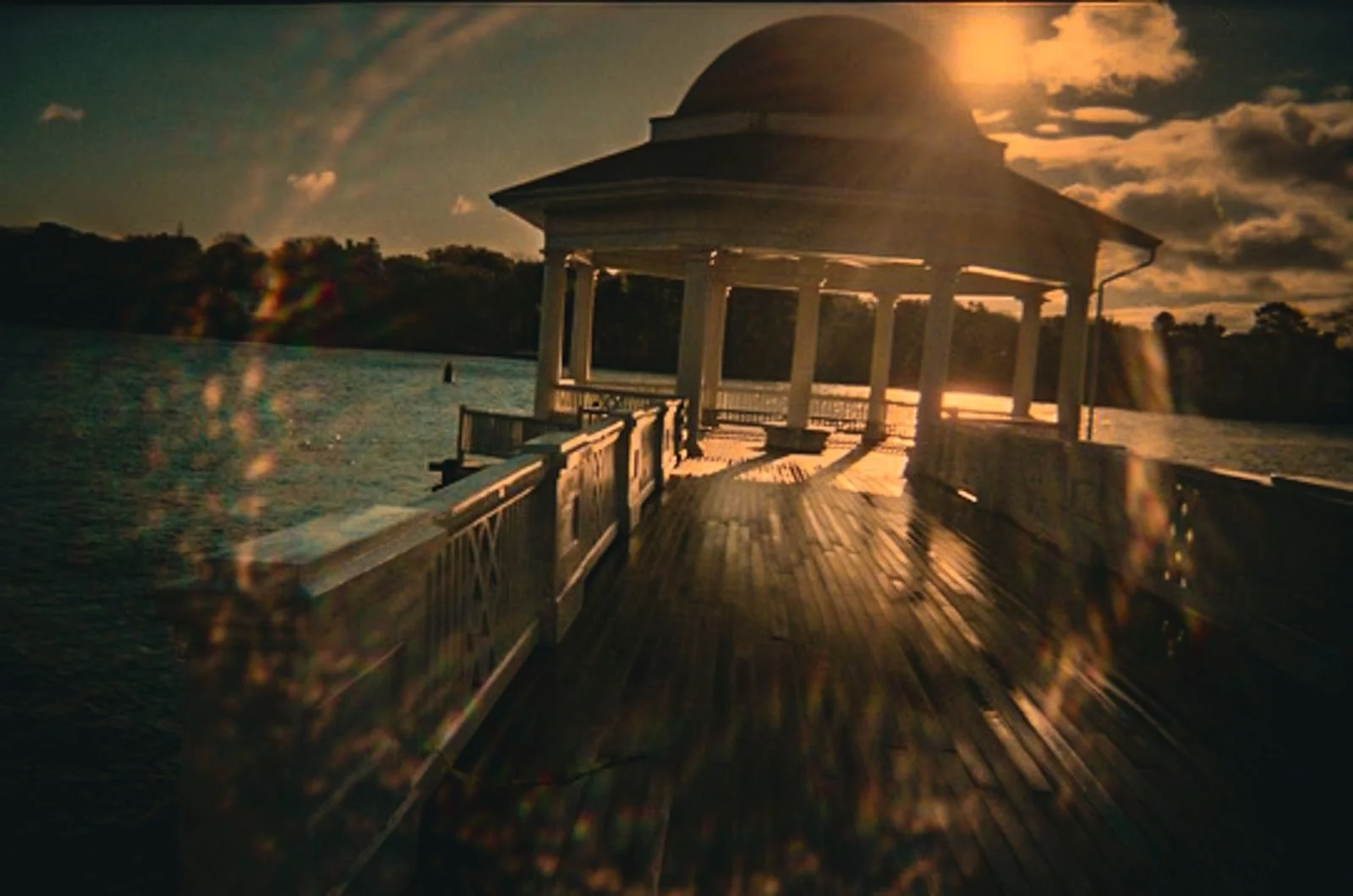
The photographer, Grace Shoemaker, is a retired healthcare professional who lives in the coastal town of Devon, Massachusetts (these names are also pseudonyms). An Episcopalian who rarely attends church, practices Reiki, and belongs to a group of women who meet periodically to interpret their dreams, she describes herself as spiritual, but decidedly “not religious.” The gazebo is a place Shoemaker experiences beauty, practices her spirituality, watches people, and spends time with family.
I like to go there and sit when it’s quiet, and when I’m at the water, that’s when I pray and I talk to God and um, it’s a quiet place usually. In the summer, it’s not that quiet but other times of year it is, and I’ve been there when [there] were weddings, and it’s just gorgeous to see the, you know, the families all together and the bride walking down. And I brought the kids there, my grandkids, and I often wonder who built it and why, and why that shape and I’m always curious what goes through people’s minds when they do that kind of thing.
It is easy to envision a bridal party processing down the boardwalk, to imagine children fearlessly leaning over the banister with string in hand to lure unsuspecting sea creatures into their traps, or to picture someone meditating, remembering, or “talking to God” in this place. Not only is the gazebo a special place for Grace, countless wedding albums mark it as a place of memory, ritual, and perhaps even sacred commitments (or at least well-intentioned promises), uttered under the watchful eye of a pastor, priest, rabbi, or civil servant. Indeed, this place is a brackish juxtaposition of nature and architecture, of the sacred and the ordinary, of family and strangers, of self and society, of God and woman. But there is more to it than that.
Underpinning Grace’s stories about this place is an understanding of how the world works. During our conversation, the light that surrounds the gazebo captured Grace’s attention. “I like this,” she said pointing to the ring of light, “the way this picture came out with the light around it.” The aura showed up in photos taken in two other locations, so it seemed natural for me to ask Grace about it. She explained, “Oh, oh, [it’s] a bunch of guardian angels or God or I don’t [know], just that spirit that’s there. There’s a spirit that’s there.” “So it wasn’t just the camera?” I probed. “No, I don’t think so,” she continued,
No, I think there’s more to it than that. It’s so pretty. I mean and maybe it was just the camera, but I think things happen for a reason. I really do, I just, I mean so many times in my life something, you know, like that where you can give it a good reason why, but there’s more to it than that. It makes it special.
Indeed, something special is happening. Behind the photo, beyond the gazebo, beneath her experiences and practices, underpinning her narrative is a set of interpretive guidelines or notions about how the world works, what is real, and what is plausible; they offer Grace a means for making sense of her everyday life. She allows for the possibility that the ordinary may also be extraordinary. These understandings travel with her; and at certain times and places, they can enchant an ordinary act, place, object, or conversation. Not only did her spirituality manifest itself when she was physically at the gazebo. It was captured in the photo and the narrative behind it and then reappeared in her living room as she offered a spiritual explanation of a photographic aberration for which someone else might attribute a material (a cheap camera), scientific (the angle at which the sunlight was refracted), or accidental cause. Her world is neither disenchanted, as Max Weber (2002) might have expected, nor has the sacred been reduced to an isolated compartment as Peter Berger (1967) once anticipated.
This interaction with Grace suggests that religion and spirituality may appear in expected and unexpected places in everyday life. It might be anticipated that many people experience a sense of the transcendent when encountering the beauty, scale, or power of the natural world. Likewise it is no surprise that a mundane gazebo might take on ritual significance at a personal
level for Grace or on a community level as a place for wedding ceremonies. More interesting is that Grace’s notions of the enchanted way the world works travel with her and govern countless other social interactions that lie beyond any taken-for-granted institutional boundaries that might be expected to surround religion and spirituality.
While Grace’s experience is unique, the pattern it suggests is not. Religion and spirituality operate across the domains of daily life. Although the presence or absence of the sacred is not always visible to the naked eye, there are often features of the social world at work that introduce a spiritual dimension in unexpected places.
Taken from “Space for God: Lived Religion at Work, Home, and Play,” by Roman R. Williams, published in Sociology of Religion (2010).