
Our Story
We employ a tried-and-true technique called photovoice, which combines amateur photography and structured dialogue. It isn’t something we invented. Our innovation is developing ways to use photovoice as an arts-based approach to interfaith understanding.
Why We Got Our Start
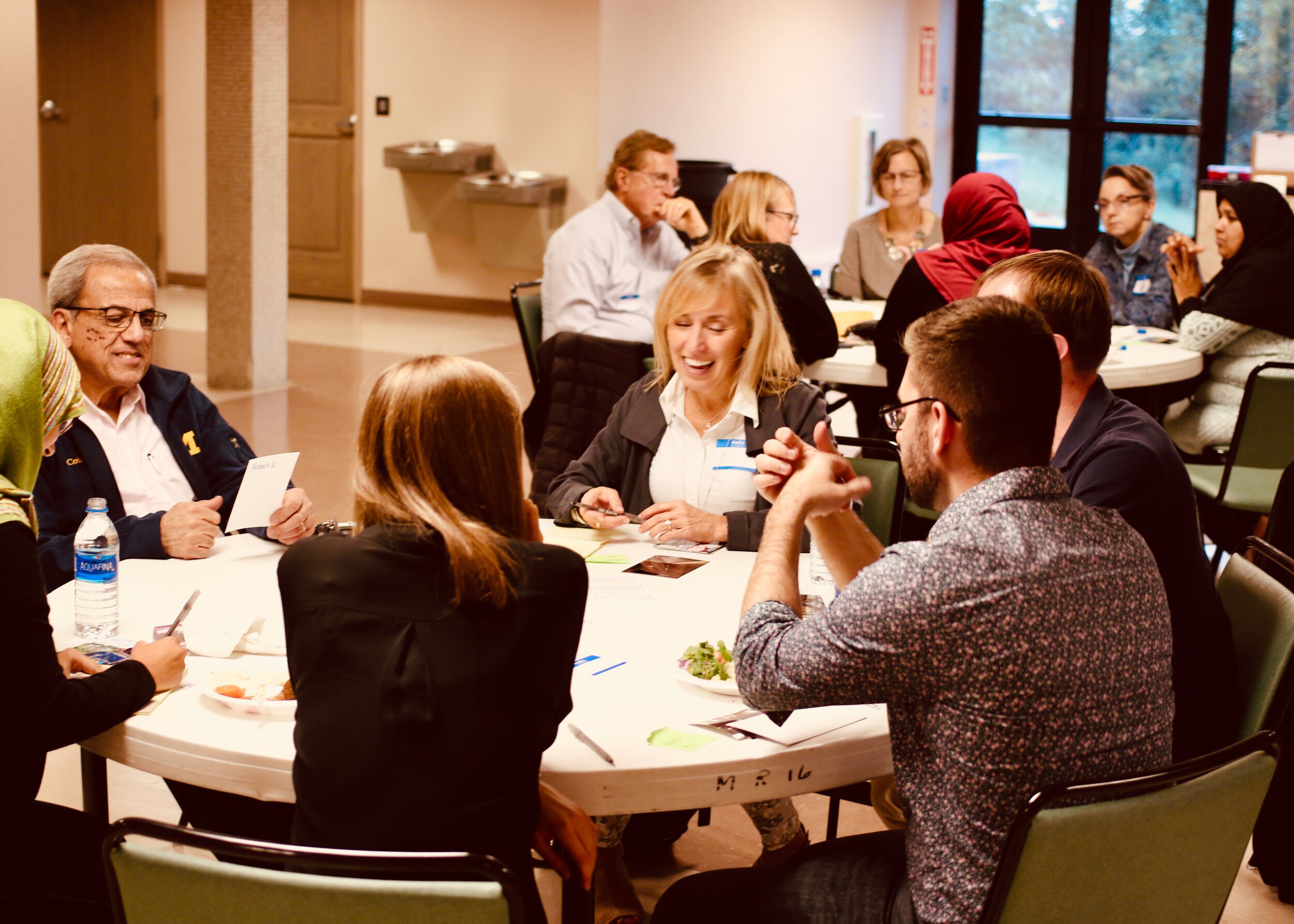
Small group conversation from one of the three pilot projects in 2018 (Grand Rapids, Michigan).
Roman and Michael drew in friends and colleagues who shared this vision. The Louisville Institute funded three pilot projects. They marveled at the results from these initial efforts. Read more about the results in this peer-reviewed journal article.
Interfaith Photovoice grew from these first three projects. The work has since opened up beyond Christians and Muslims to include people of any religious, spiritual, or secular identity. We’ve also worked around other divisive issues, such as political partisanship.
These days we partner with schools, colleges and universities, non-profits, governments, congregations, businesses, and foundations.
Interfaith Photovoice was founded to strengthen ties and pursue change among members of different religious affiliations living in the same local communities. It began as a response to the growth of Islamophobia and anti-immigrant rhetoric in the United States on the eve of the 2016 presidential election.
In January of 2017, Roman Williams, a visual sociologist of religion and the founder of Interfaith Photovoice, had lunch with his friend Michael Bos, a Christian minister with eight years of experience with on the ground interfaith and peace building experience in the Sultanate of Oman. They both worried that election campaign statements made by the incoming president, and others on the campaign trail, about Muslims and immigrants would translate to harmful policies.
An idea sparked during that conversation: What if we could use photovoice to help build relationships, understanding, and community among Christians and Muslims?
Origins of Photovoice
Photovoice is not our own invention. It grew out of an early-1990s Ford Foundation-supported program in rural China called the Yunnan Women’s Reproductive Health and Development Program. The original work in Yunnan that would grow into a full-blown methodology foresaw a direction of research that could shoulder social change instead of simply studying it.
Ford Foundation program officer Mary Ann Burris recommended photography be added as a way to help rural village women document their everyday lives. University of Michigan public health scholar and photography enthusiast Caroline Wang joined the team and helped train sixty-two women from rural villages in Yunnan Province, a underdeveloped and inequitable region of China in the 1990s, in the basics of photography. The women documented the realities of their health, work, and family lives through their pictures.
Participants shot a roll of film each month and gathered quarterly to discuss their photographs.
Program staff helped the women, some of whom could not read or write, by preserving the stories behind their photos in the women’s own words. The women were empowered to engage policymakers and eventually made a real, tangible impact on their communities. This is where photovoice got its name: the photos gave these women a voice.
The photos didn’t just etch the problems in a community onto film; they were used to advocate for systemic change. The establishment of the day care cooperatives in Yunnan became an early example of the role of photovoice in social change. Other initiatives to come out of the original project, according to Burris, were midwifery training, increased efforts to encourage girls to attend school, and improvement of health services.
From its inception, empowerment and action have been foundational to photovoice. Over the last three and a half decades, photovoice has been used to address issues such as poverty, housing, mental health and stigma, food access, healthcare, and a host of social concerns.
Read more about the origins of photovoice as a methodology here. And learn about how our approach builds on this here.