
Relational Religious Literacy: What It Is & Why It Matters
We can’t get along if we know nothing about each other. As Rabbi Joachim Prinz, German-American Jewish leader & Civil Rights advocate, taught “Neighbor is not a geographic term. It is a moral concept.”
Neighbors know something about each other. Sure, they might know your name, what you do for work, and what kind of car you drive. Most neighbors, especially good ones, will also know more than just the facts. They will know something about your routines. If you’re friendly with each other, they might have firsthand knowledge of the inside of your home and the way you parent your kids. And they probably even know about the way you spend your time and who you spend it with. Their knowledge of you isn’t purely factual. It is relational.
Religious literacy is also like this. The way most interfaith educators and dialogue leaders approach religious literacy is what we might think of as textbook heavy. It is all about facts: how many times a day Muslims pray, what Catholics are praying when they hold their rosaries, what “sitting shiva” means for Jews.
These sorts of facts are important and helpful. They do tell us something about people with different beliefs and practices than us. But religious literacy, if limited to a series of checkboxes or facts about a religious tradition, will be fickle, incomplete, and shallow.
Instead, to truly learn something about the religious other, our knowledge of them must center the person and their individual experiences. This is because religion isn’t something that stays in textbooks. Real people live it out.
Our work takes a different approach. We call it relational religious literacy. Relational religious literacy grounds the knowledge of religion and spirituality important in individuals.
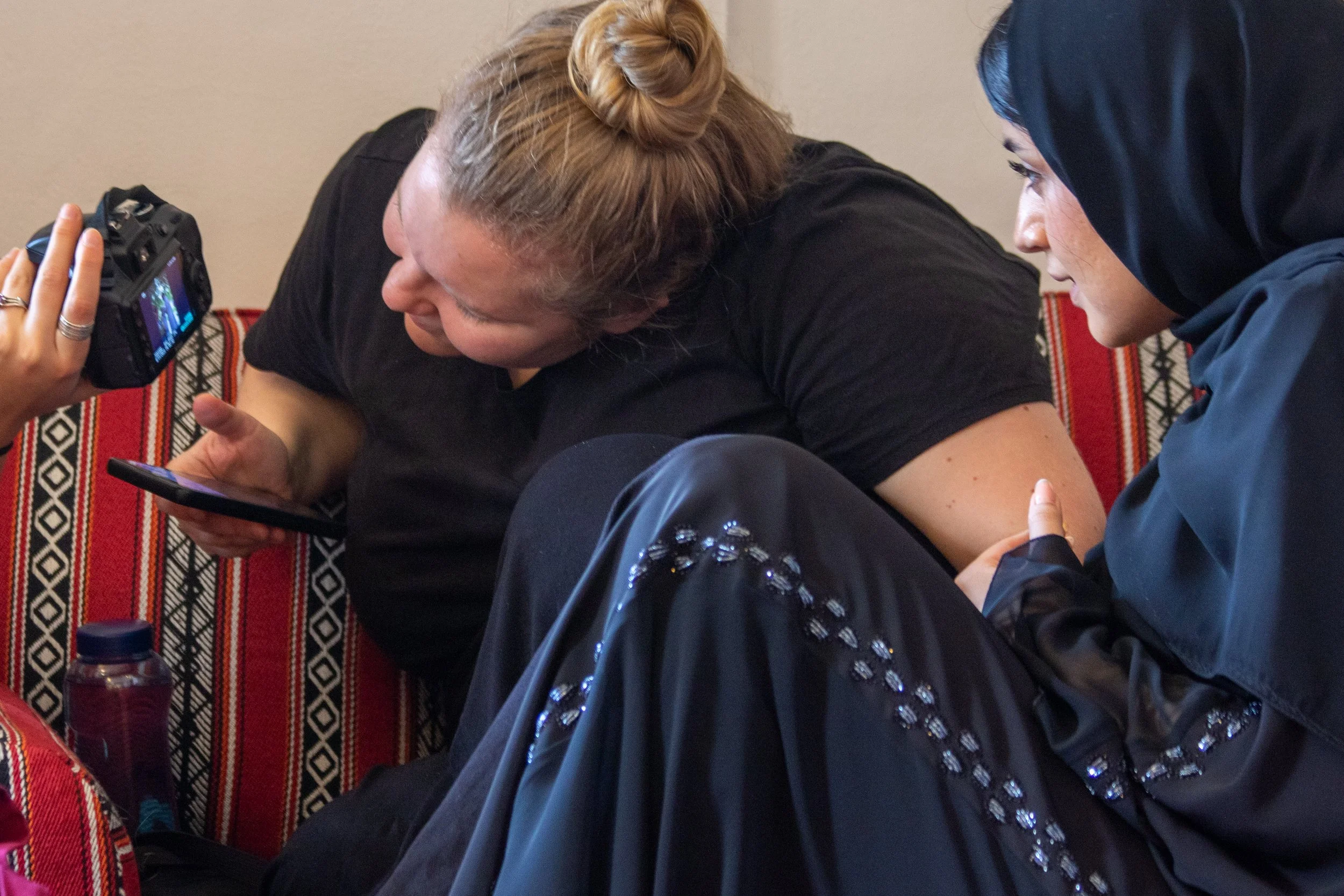
The most important aspect of relational religious literacy is that it helps learners (or, in our case, photovoice participants) become more familiar with the diverse experiences of religious traditions in a way that resists tokenization. To learn the textbook information that “Muslims pray five times a day” simplifies both actual Sharia practices (the Shi’ah Ja'fari school of jurisprudence, for example, allows prayers to be combined) and can turn all Muslims into fully observant stereotypes.
To learn about someone’s prayer practices on a relational level changes the game entirely. Imagine a dialogue session where participants bring photos of the important practices and routines in their everyday lives. Zeynep might share in a photovoice discussion that she rarely does all five prayers. When she thinks of her own Muslim identity, other things come to mind first, such as keeping halal or watching Ms. Marvel with her brother. Her photo of prayer could be a scene from the show rather than from her own life. Ali, in the same discussion, says he tries his best to do all five but finds himself frequently hesitant to do so in public, fearing white nationalists. He takes a photo showing how ablution is also hard for him to perform in his day job as a nurse. He wants to pray more though. Mohammed, on the other hand, never misses a prayer and even brings to attention the diversity of prayer within Islam. He isn’t Shi’ah, but holds a lot of admiration for the turbah, a piece of clay symbolizing the Earth that many Shi’ah Muslims touch their foreheads to while prostrating. In a similar way that the turbah connects prayer to Allah’s creation, he prefers to pray outside when he can. The photo he shared in the group was of his prayer rug resting on top of the grass on a hot summer day.
For the non-Muslims in our imagined group, their touchpoints with Muslim prayer resists the tokenization of a textbook. The next time they see a Muslim man kneeling outside, they will certainly think of their new friend Mohammed and how he beautifully connected prayer and creation in his turn to share. The same thing happens for Mohammed, Ali, and Zeynep in their intrafaith engagement; and they experience something similar when Rafi and Emmanuel share about the incredibly distinct ways they daven.
While this group may be imagined, the results of conversations like these are real: people learn to see and feel the world through one another’s lenses. We observe people building relational religious literacy in every photovoice session we facilitate. It reinforces the retention of knowledge through interpersonal relationships.
As it relates to our methodology, you’ve probably heard it said before that a photo is worth a thousand words. The science backs this up: photos are more memorable than other forms of information. This is why months after a photovoice session participants may see something in their daily life — a halal sticker on meat at the grocery store, perhaps an eruv, something about prayer — that reminds them of something someone shared during the project. This helps develop empathy and a shared sense of purpose across differences.
Relational religious literacy prioritizes the individual and empowers participants to be experts on their own lived experiences. And this makes all the differences since religion is something that real people live. It cannot be reduced to mere facts, graphs, and a summary of important figures.
Relational religious literacy is an invitation to learn something about the religious other in a way that only a good neighbor can.