
The Personal Vantage Point
Before experiencing Interfaith Photovoice, I thought I knew what photography was for. As a student photographer at university, I saw photographs as either images that were supposed to be beautiful and visually exciting, tools for data collection, or sentimental snapshots that preserved memories to hold close. None of these purposes is wrong, but I had not thought very much about what else photography could do.
Then, in February, I participated in the Interfaith Photovoice workshop at Duke University, facilitated by Roman Williams. The workshop opened a new door for me. It made me think about photography not simply as an artistic medium, but as another way of seeing, experiencing, and communicating the world around me.
What truly struck me was the potential of photography as a religious medium. First and foremost, I am a university student majoring in religious studies. Most of my academic materials and expected work are densely textual. I often feel frustrated, even now, by how static much academic material can feel, especially in a fast-paced, stimulating, and interactive world. The Interfaith Photovoice workshop showed me another possibility: photography could become an assisting medium in my religious and academic work. It could help make sense of the religious world in ways words alone cannot. That idea ultimately inspired me, with the support of my university, to undertake a religious research project in the Tibetan regions of China this summer using photographic methods.
A glimpse of Tibet from the road: mountains, pastures, streams, pools, and plenty of yaks.
During my journey, I’ve come to realize the strength of photography is that it records information from a personal vantage point. As I traveled across the Tibetan Plateau, I was not simply taking photographs; I was doing so from my own perspective, from a specific vantage point at a specific moment. Every photograph comes from my unique personal vantage point. It is, in some sense, a pixelated extension of my own eyes at that moment: looking in one direction, through a limited frame. It is a record of what I saw.
The personal vantage point makes photographs deeply intimate. It provides a strange sense of reality, uniqueness, and temporality. However, the personal vantage point also means that every photograph is an incomplete fragment, necessarily missing something.
Every sound, feeling, and other sense disappears. I might photograph a quiet landscape, but I cannot photograph all of the sounds around me at the same time. I might capture a person performing Tibetan prostrations, but the photograph records only one moment in a continuous movement. I might capture sunlight falling across a landscape, but not how that same light looked five minutes earlier. I cannot simultaneously capture the cutting wind, the cold air, and the burning sun that I experienced at that moment of clicking the shutter.
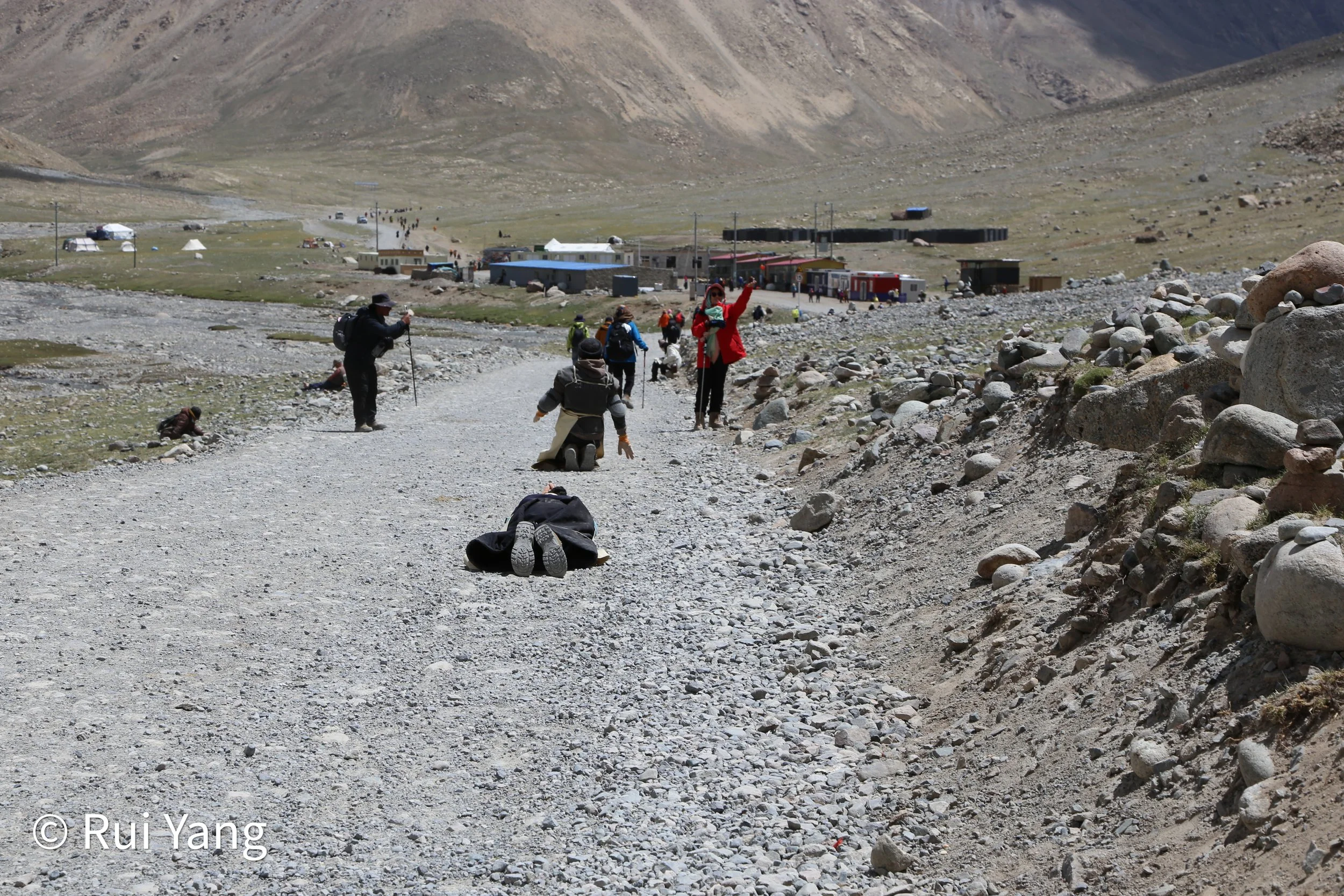
Two Tibetan pilgrims perform Tibetan prostrations with every step. I can capture a moment of the practice, but not its full motion.
When a photograph is taken, the photographer points the camera in one direction. Everything behind the photographer disappears. Everything outside the field of the eyes and through the lens disappears. Every sound, feeling, and other sensations disappear. I cannot photograph musical chants in a way that does them justice.
Most importantly, while we capture a moment in time, time itself disappears. A photograph is a moment preserved in pixels: a fragment of what was and what can never be again. That is incredibly valuable. A photograph becomes a record and a window into the past, but it is also necessarily incomplete.
There is always something beyond the frame.
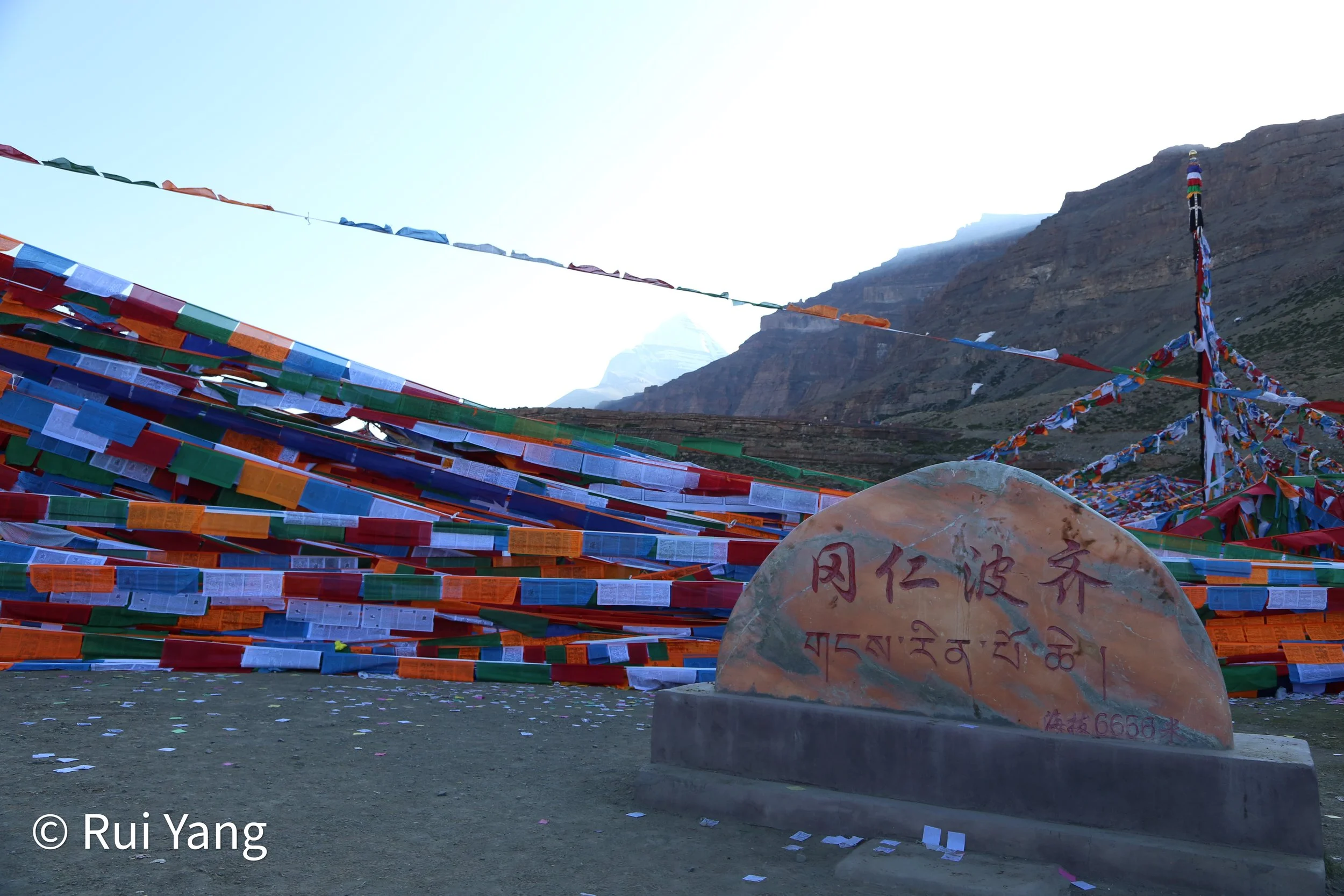
I was at the prayer flag plaza at Kangrinboqê (Mount Kailash). A sign bears the name of the sacred mountain in Chinese and Tibetan, surrounded by prayer flags, with the gentle silhouette of Kangrinboqê in the distance. Yet the photograph cannot capture the immensity of the landscape around me.
Looking at an image, a viewer cannot know everything that was happening beyond the perspective captured in the frame. Instead, viewers wonder: what was outside the frame? What did it feel like? What happened before I snapped the moment? What happened afterward? What was going on in another direction?
That incompleteness and intemporality is part of what makes photography so powerful. Its limitations leave room for imagination.
Yet, to a photographer, there is another, even stranger quality to this personal vantage point: what is inside the frame can contain things that I did not see and no longer remember.
When I look back at photographs later, I often discover details that I did not notice when I took them: how dark a shadow looked, a small detail in the background, or the way someone was standing. At the time, I may have been focused on one particular subject within my personal vantage point, but the photograph preserved much more than I consciously noticed. When I revisit it, I can expand that vantage point. What I photographed is not always the same as what I was seeing at the moment I took the photograph.
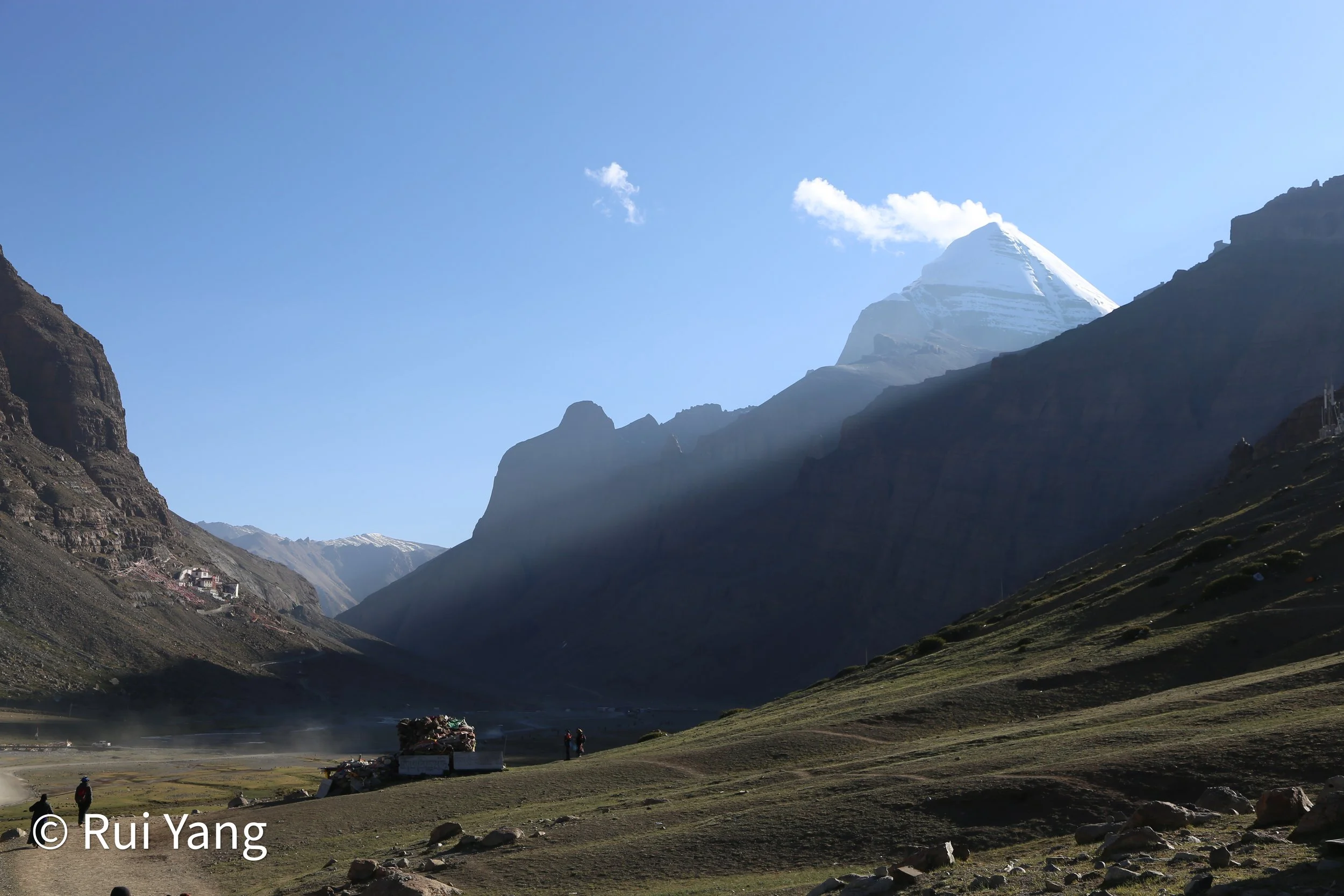
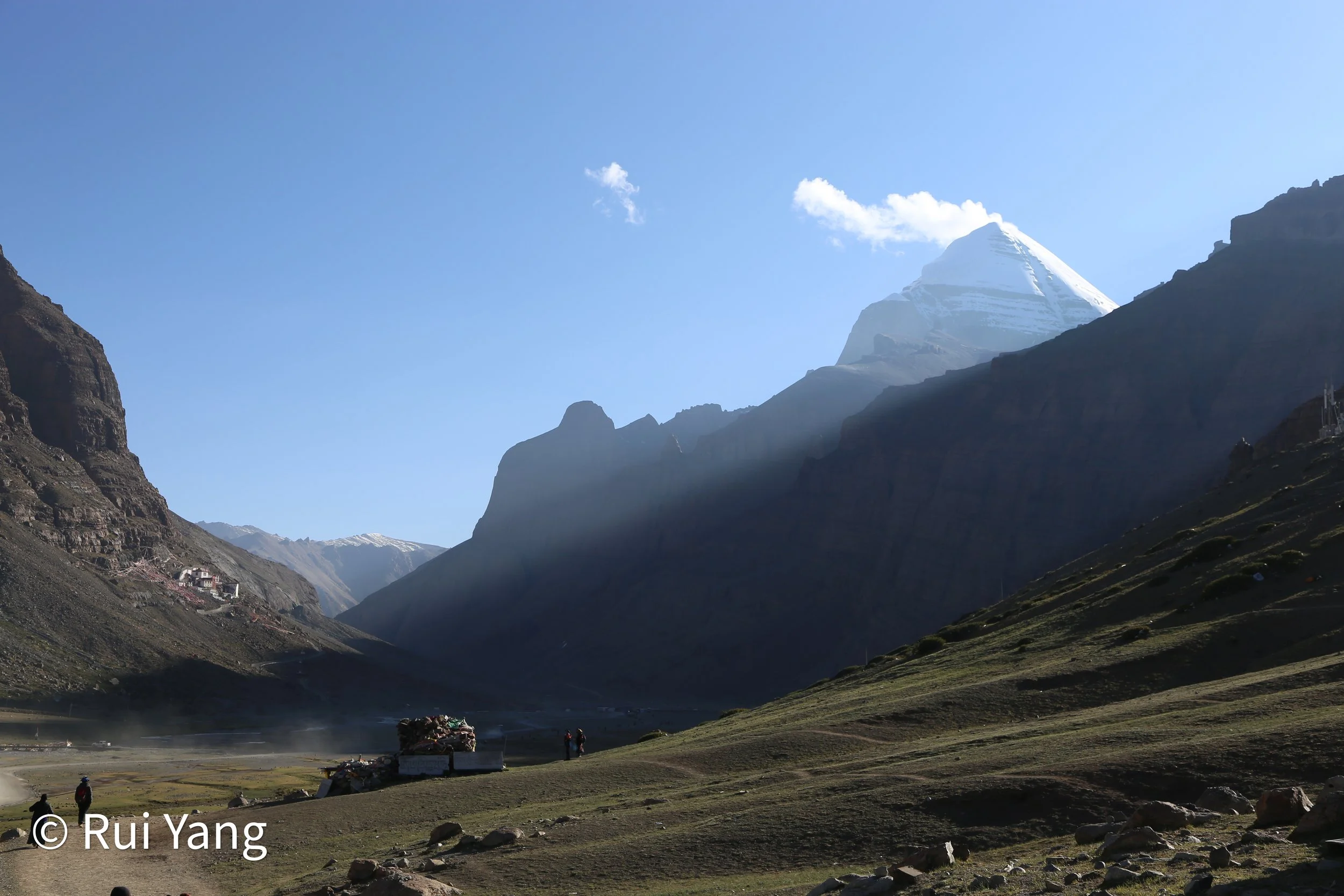
Kangrinboqê stands on the right, with a temple nestled in the cliffs on the left. As the wind moved clouds across the sky, the light constantly shifted. Just a few minutes later, the light and the landscape were already different.
A photograph, then, tells us everything all at once and nothing at all. It is the result of our personal vantage point, yet there is always something beyond the frame. It is a fragment of an experience that we can never fully return to or recall. It preserves temporality while simultaneously removing the photograph from the time in which it was created.
And perhaps most importantly, the photograph itself does not remain the same to us. As we view and revisit it, our imagination and response to the photograph change because we change. We may notice something we had previously overlooked. We may remember the circumstances differently. We may have forgotten what happened immediately afterward. The photograph may
remain physically unchanged, but our vantage point toward it is constantly changing. That is reflective of our identity as ever-changing people.